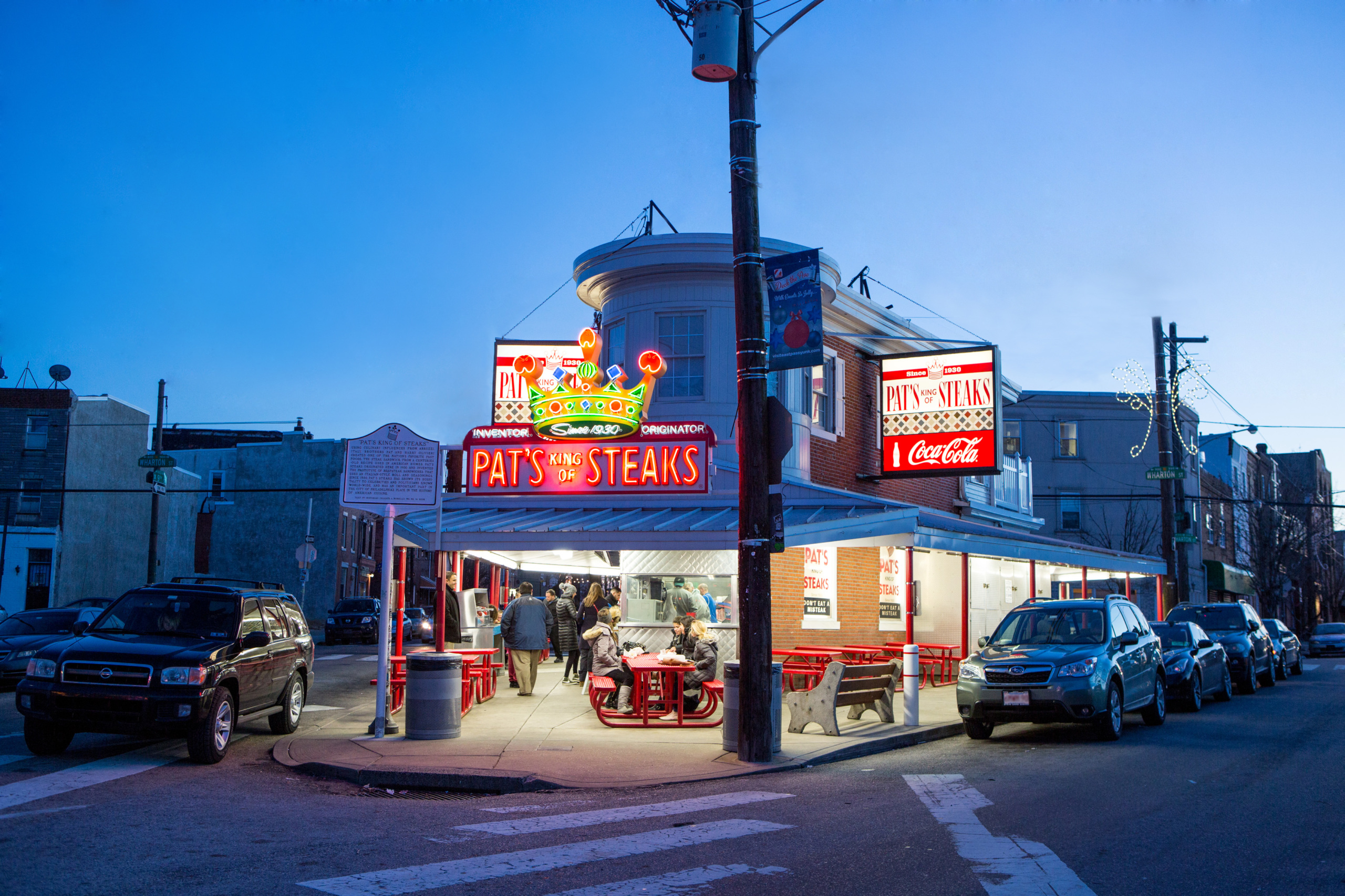
Across the street from the neon fever dream of Geno’s sits the elder statesman of grease, the self-proclaimed birthplace of the Philadelphia legend: Pat’s King of Steaks. Since 1930, they’ve been slinging meat on rolls at this intersection, and as a food production manager, I appreciate the history. But history doesn’t season the meat, and legacy doesn’t melt the cheese. While Pat’s avoids the garish lights of its neighbor, it falls into a different trap: the complacency of being the “original.”
Walking up to the window is a ritual unchanged by time. It is industrial, it is efficient, and it is entirely devoid of warmth. You order, you pay, you move. From a production standpoint, it’s a marvel—a high-volume machine that produces a sandwich in seconds. But speed is often the enemy of nuance.
The fundamental difference here is the preparation of the protein. Unlike the sliced sheets at Geno’s, Pat’s utilizes a chopped-steak method—at least in theory. In practice, the chop is often inconsistent, resulting in a pile of beef that is occasionally tender but frequently dry. Because the meat sits on the griddle in massive heaps to accommodate the tourist throngs, the moisture—the lifeblood of a good steak—evaporates into the South Philly air.
Then we have the “Whiz.” At Pat’s, the application is often a single, utilitarian ladle-thwack across the top. Because the meat isn’t integrated with the cheese during the cooking process, you end up with a sandwich of two halves: a dry, salty bottom and a gooey, orange top. The “Whiz” itself is thinner than I prefer; it lacks the velvety viscosity that should bind the onions and beef into a singular, decadent unit.
The roll, sourced from Liscio’s, is arguably the strongest player on the team. It is soft and yielding, designed to be crushed in the hand, but it lacks the structural fortitude to truly stand up to the grease. By the time you’ve navigated the sidewalk to find a standing-room-only spot to eat, the bread has already begun its descent into a sodden, doughy state.
- Chopped Meat: Offers more surface area than sliced, but frequently suffers from over-griddling, leading to a dry texture.
- Cheese Integration: The Whiz is a top-down affair; without a proper “toss” on the grill, the flavor remains segregated from the beef.
- Onion Ratio: Generally generous, providing the necessary sweetness, though the quality of the sauté can vary wildly between shifts.
- Historical Context: You are eating a piece of history, which is fine, but history rarely satisfies a craving for culinary excellence.
Pat’s is a rite of passage, a box to be checked on a culinary bucket list. It is a competent sandwich that fulfills the basic requirements of the form, but it lacks the passion and the technical precision of the city’s true elite. It is the “Original,” but being first does not mean being the best.
3 Tsar Stars 🌟🌟🌟
Leave a Reply