Greetings once again, my esteemed gastronomes, fellow travelers on this endless, often treacherous, journey through the world’s kitchens. It is I, the Tsar, returned from the labyrinthine streets of Philadelphia, a city steeped in history, yes, but also, as I have come to discover, a city grappling with the complexities of its culinary identity. Today, we delve not into the avant-garde, nor the obscure, but into the comfortably familiar, a locale many of you may already know: Maggiano’s Little Italy. Prepare yourselves, for the Tsar’s analysis, as always, is unvarnished, a mirror reflecting not merely the dish, but the very soul of the establishment.
My journey to Maggiano’s was not born of fervent anticipation, I assure you. Rather, it was a pilgrimage of necessity, a quest to assess how a prominent chain, one so often lauded for its consistency, truly measures up under the unforgiving gaze of a palate honed by years of rigorous, uncompromising scrutiny. Consistency, you see, is a double-edged sword. It can be the hallmark of a well-oiled machine, a testament to meticulous process and quality control. Or, it can be the monotonous drone of predictability, a plateau where innovation fears to tread, and true culinary artistry is stifled in the pursuit of mass appeal. The question that loomed large as I approached the establishment was this: which side of the sword would Maggiano’s fall upon?
The ambiance, upon entering, was precisely as one might expect. A studied, almost theatrical rendition of an old-world Italian-American trattoria. Dark wood, checkered tablecloths, the murmur of conversations punctuated by the clinking of glasses and the occasional burst of laughter. It possessed a certain comfortable familiarity, a warmth that, for many, is the very essence of a family meal. However, for the discerning critic, it also raised immediate questions. Was this genuine warmth, an organic emanation of hospitality, or a carefully constructed facade, designed to evoke a feeling rather than genuinely embody it? The distinction, though subtle, is paramount. A truly great restaurant doesn’t merely serve food; it cultivates an experience, an atmosphere that enhances, rather than merely frames, the culinary journey.
My initial observations of the menu confirmed my suspicions. A comprehensive, yet largely unadventurous, selection of Italian-American classics. Lasagna, spaghetti and meatballs, chicken parmesan – the usual suspects. There is, of course, a comforting predictability in such offerings, a reassurance that one will likely find something palatable. Yet, for a critic, this predictability can often signal a lack of ambition, a reluctance to venture beyond the tried and true, to truly push the boundaries of flavor and presentation. My mission, however, was not to seek out the exotic, but to assess the execution of the familiar. Can a chain, operating on a grand scale, truly elevate these classics beyond mere sustenance to something approaching culinary art? This was the true test.
My culinary exploration commenced, as it often does, with a careful selection of appetizers, those delicate harbingers of the meal to come. And it was here, amidst the customary offerings, that a glimmer of intrigue emerged. The charcuterie board.
In an era where every establishment, from gas station delis to Michelin-starred restaurants, seems to offer some rendition of cured meats and cheeses, the challenge lies not in its mere presence, but in its execution. All too often, it devolves into a haphazard collection of bland cold cuts and forgettable cheese, a mere filler designed to appease rather than to truly impress. However, at Maggiano’s, a surprising revelation unfolded.
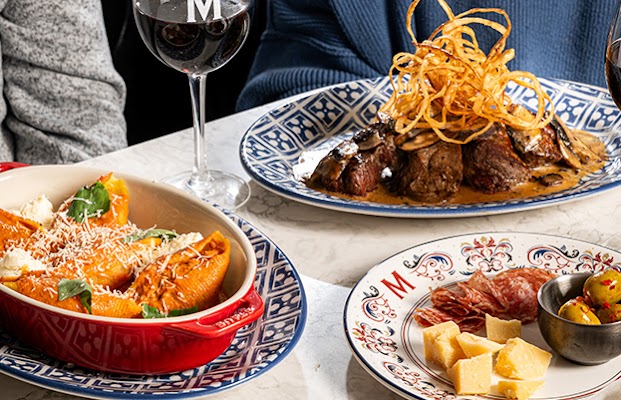
The presentation, first and foremost, was commendable. A generous spread, artfully arranged on a sturdy wooden board, suggesting a certain gravitas and intention. My eyes, accustomed to discerning quality from mere visual appeal, immediately noted the varied textures and hues of the cured meats. Prosciutto, thinly sliced to an almost translucent gossamer, its delicate marbling promising a whisper of salt and sweetness. Salumi, robust and assertive, with hints of fennel and spice. And a spicy soppressata, its vibrant crimson hue hinting at a delightful, yet not overwhelming, heat. This was not merely an assemblage; it was a carefully curated selection, demonstrating an understanding of the interplay between different flavor profiles.
The cheeses, too, held their own. A creamy, ripe brie, its earthy notes providing a gentle counterpoint to the more assertive meats. A sharp, aged cheddar, its crystalline texture and nutty flavor adding depth. And, to my pleasant surprise, a crumbly gorgonzola, its pungent, piquant character offering a delightful challenge to the palate. While none of these were artisanal masterpieces, plucked from obscure Alpine dairies, they were, crucially, fresh, well-maintained, and served at the appropriate temperature, allowing their inherent qualities to shine through. This is a detail often overlooked, yet absolutely vital for the full appreciation of cheese.
The accompaniments were equally well-chosen and executed. A medley of olives, briny and firm, provided a palate-cleansing counterpoint. A vibrant, homemade fig jam, its sweetness a delightful foil to the savory elements, demonstrated a touch of culinary thoughtfulness. And the crusty bread, toasted just so, with a perfect chewiness, served as an ideal vehicle for the various components. This was not an afterthought; it was an integral part of the experience, elevating the charcuterie from a mere plate of nibbles to a miniature feast.
What truly distinguished this charcuterie board was its balance. Each element played its role, contributing to a harmonious whole without overpowering its companions. The saltiness of the meats was perfectly tempered by the sweetness of the fig jam and the creaminess of the brie. The sharpness of the cheddar found its counterpoint in the subtle notes of the prosciutto. It was a symphony of flavors, a delicate dance across the palate, demonstrating a level of care and understanding that is all too rare in establishments of this scale. It spoke of a kitchen that, at least in this instance, understood the subtle art of combination, the careful orchestration of individual components to create a unified and satisfying experience.
It is for these reasons, for this surprising demonstration of nuanced understanding and commendable execution, that I, the Tsar, bestow upon Maggiano’s Charcuterie Board a most respectable 4 Tsar Stars 🌟🌟🌟🌟. It is an offering that transcends the ordinary, a beacon of quality in a menu that, elsewhere, often veers towards the predictable. It is a dish that I would, without hesitation, recommend to any discerning diner seeking a well-crafted start to their meal, a delightful prelude to whatever culinary journey they choose to embark upon.
However, let us not be swayed into a premature declaration of overall triumph. A single excellent dish, while noteworthy, does not define an entire restaurant. My subsequent culinary explorations at Maggiano’s, I must confess, painted a more… familiar picture. The pasta dishes, while generously portioned and perfectly al dente, lacked that spark of innovation, that profound depth of flavor that separates good from truly great. The sauces, while perfectly acceptable, clung to the established tropes of Italian-American cuisine, offering comfort but little in the way of revelation. One longs for a hint of something unexpected, a secret ingredient, a technique perfected over generations that elevates a simple marinara to an unforgettable experience. Here, alas, comfort trumped transcendence.
The main courses followed a similar trajectory. A chicken parmesan, crispy and succulent, was undeniably satisfying. Yet, it was precisely that: satisfying. It did not challenge, it did not surprise, it did not linger in the memory as a benchmark against which all future chicken parmesans would be judged. It was a well-executed rendition of a classic, a testament to competent kitchen management, but not a display of culinary genius. This, I posit, is the inherent paradox of the chain restaurant. To appeal to a broad demographic, one must often sacrifice the daring, the experimental, the truly transformative. The risk of alienating a segment of the clientele often outweighs the potential reward of achieving true culinary distinction.
And this brings us to the Tsar Stars, my personal metric for evaluating the very essence of a dining experience. A good many dishes at Maggiano’s, the bulk of its offerings, would comfortably reside in the 3 Tsar Stars 🌟🌟🌟 category. These are dishes that are perfectly enjoyable, competently prepared, and deliver on their promise of familiar comfort. They are the reliable workhorses of the menu, the dishes you can order with confidence, knowing they will not disappoint, yet also knowing they will not astound. There is a certain utility in such consistency, a peace of mind that can be valuable in its own right. Not every meal, after all, needs to be a revelation. Sometimes, one simply desires a well-executed plate of pasta or a comforting lasagna. And in this regard, Maggiano’s largely delivers.
However, as a true critic, one must also highlight where expectations fall short, where the promise of a dish, however humble, remains unfulfilled. And yes, there were moments, brief and fleeting, where certain offerings, perhaps a side dish, or an overly zealous application of seasoning, drifted into the 2 Tsar Stars 🌟🌟 territory. These are not outright failures, mind you, but rather instances where the execution faltered, where the balance was slightly off, or where the dish simply failed to achieve even its own modest potential. These are the subtle missteps that, while not ruining a meal, certainly detract from the overall experience, reminding one that even in the pursuit of consistency, vigilance is paramount.
The elusive 5 Tsar Stars 🌟🌟🌟🌟🌟 remains, for Maggiano’s, a distant dream. Such a rating is reserved for destinations that transcend the ordinary, for culinary experiences that are truly transformative, that linger in the memory long after the last morsel has been savored. These are the places where every element, from the initial greeting to the final espresso, is meticulously crafted, where innovation dances gracefully with tradition, and where the very act of eating becomes an art form. Maggiano’s, while commendable in its own right, does not aspire to such heights. Its mission, it seems, is to provide a reliable, comforting, and generally pleasing Italian-American dining experience, and in this, it largely succeeds. But for the rare, transcendent culinary moment, one must, alas, look elsewhere.
In conclusion, my culinary compatriots, Maggiano’s Little Italy in Philadelphia presents a fascinating case study in the complexities of the modern restaurant landscape. It is a place that understands its audience, delivering a consistent, comforting, and largely enjoyable experience. The charcuterie board stands out as a genuine highlight, a testament to what can be achieved with thoughtful curation and careful execution, earning its well-deserved 4 Tsar Stars. Yet, the broader menu, while perfectly acceptable, rarely ventures beyond the expected, residing comfortably in the realm of 3 Tsar Stars.
So, should you find yourself in Philadelphia, seeking a familiar embrace of Italian-American fare, Maggiano’s is a perfectly respectable choice. Just be sure to start with the charcuterie. And remember, the Tsar’s quest continues, ever vigilant, ever discerning, forever in pursuit of that elusive, breathtaking moment of culinary perfection. Until next time, may your plates be full, and your palates be challenged.
Leave a Reply